September 2026
Autumn is officially upon us and back-to-school season is in full gear, as is aiEDU. In this edition, we are recapping the surprisingly busy summer months and providing a look ahead to the last quarter of the year. Four things to highlight: aiEDU announced a new class of Community Catalyst grantees, the fall Trailblazer Fellowship is kicking off soon, we published our first mid-year impact report, and we have some exciting opportunities to engage in K–12 Messaging Research on AI Readiness.
Program Spotlights
Trailblazer Fellowship: 3 Years In
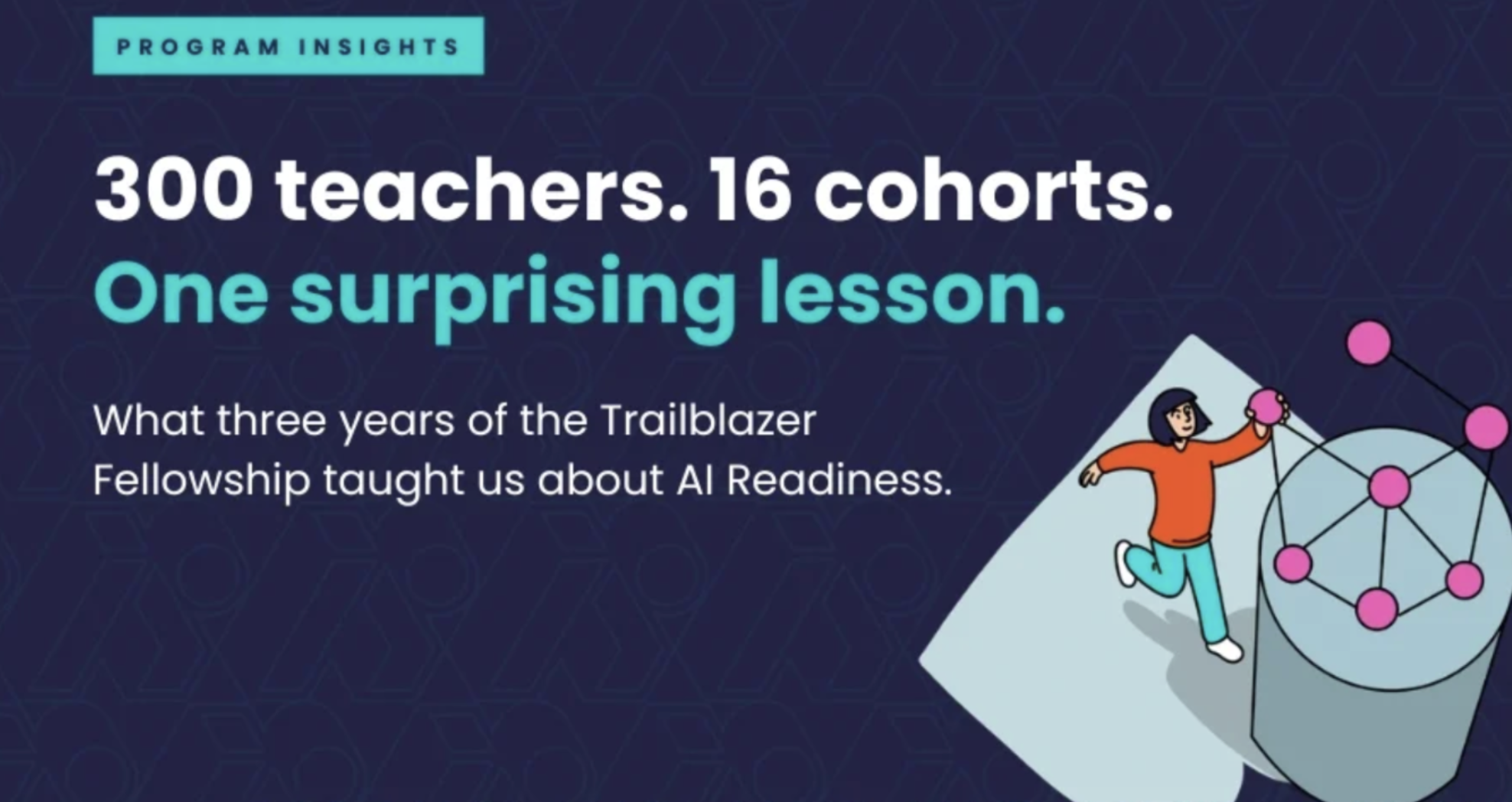
aiEDU is in our 3rd year of offering the Trailblazer Fellowship, a 12-week commitment with synchronous sessions, asynchronous activities, a teacher stipend, and a certificate of completion. To date, there have been 16 cohorts and 300+ teacher fellows across 40 states that completed the program. We have a lot to share from this work, which we encourage you to learn more about in our blog post, “Three Years of Trailblazers: What 300 Teachers Taught Us About AI Readiness.”
Applications for the five fall 2026 cohorts closed on August 24. We received 460 applications for 175 spots. Trailblazer Fellows have been notified and will begin their fellowship next week!
Community Catalyst: Meet the 2026 Grantees
Since 2024, aiEDU has provided $1.45M in Community Catalyst subgrants to 28 organizations across 19 states. In July, we announced our third round of grantees for aiEDU’s 2026 Community Catalyst program, covering seven projects across six states and reaching more than 1,100 educators and 30,000 students. Beyond funding, every grantee will receive direct support from aiEDU — including train-the-trainer programming, strategic advising, and coaching — and will convene as a cohort throughout the grant year for peer connection and collaboration. While only seven grants were able to be awarded, we received 139 letters of intent across 45 states. Learn more about this work and meet the grantees, including Capital Region ESD 113 in Washington, which was recognized by the Center for Public Sector AI for its Catalyst project.
Recently Released! NEW aiEDU Classroom Resources
Vibe Coding, Built for Every Learner (aiEDU + CAST)
Following the vibe coding workshops aiEDU co-hosted with CAST this spring, Christian Pinedo from aiEDU and the CAST team have published a joint write-up and a free companion resource for educators. The workshops paired aiEDU’s build-first approach to AI with CAST’s Universal Design for Learning framework, demonstrating that when teachers build their own classroom tools, accessibility can be designed in from the first prompt instead of retrofitted later. Read the CAST + aiEDU write-up or download the workshop resource (PDF).
Thought Leadership & Advocacy
New Research: What Earns Community Trust on AI
One of the most common things we hear from district leaders right now is that they aren’t sure how their communities will react to AI — and that uncertainty is slowing good work down. There’s plenty of polling on how people feel about AI, but almost nothing that tests what actually earns trust.
That’s the gap aiEDU and SquadBuck set out to fill. Together we’re running focus groups this fall with a national sample of K–12 parents and educators, followed by a national survey, which will result in messaging and engagement guidance that school systems can put to work right away.
We hosted a briefing for philanthropic partners in August, and we’ve made the materials available:
We’re assembling a group of aligned funders to support the three phases of work over the next 5 months, and there’s still room at the table! If supporting this effort is of interest — or if you have research to share and partners we should be talking to — we’d welcome the conversation. Reach out to Josh Westfall, Director of Development at aiEDU (josh.westfall@aiedu.org).
Teachers as Tool Evaluators
Our first professional learning community focused specifically on AI tool evaluation wrapped this spring with University Prep Schools, a Detroit charter network. Seven educators built their own evaluation criteria, tested tools in their classrooms, and made real start/stop decisions, adding environmental impact as a criterion of their own along the way. Read what happened when teachers led the vetting.
AI Readiness in the News
- aiEDU Studios Podcast (6/25/26): Andy Rotherham, co-founder of Bellwether — Why AI Makes Knowing Things Matter More
- aiEDU Studios Podcast (7/2/26): Carole Basile, Dean of ASU’s Mary Lou Fulton College for Teaching and Learning Innovation — Why Banning AI in Class Is the Wrong Fight
- Substack (7/8/26): A Practical Guide to the Looming(?) AI Bubble
- aiEDU Studios Podcast (7/9/26): Chong-Hao Fu, CEO of Leading Educators — Why Schools Should Bet on Teachers, Not Tools
- aiEDU Blog (7/13/26): Lead the Learning Before You Lead the Change
- BBC News (7/16/26): Alex featured on the segment AI Bosses Call for Industry Slowdown
- PR Newswire (7/23/26): aiEDU Announces 2026 Community Catalyst Grantees, Backing Educator Capacity Building Across Rural and Indigenous Communities
- aiEDU Blog (7/27/26): Vetting AI Tools: What Happens When Teachers Lead?
- aiEDU Blog (8/10/26): Three Years of Trailblazers: What 300 Teachers Taught Us About AI Readiness
Looking Ahead
2026 Funders
June 2026
While May was about visible momentum, June was about deepening the foundation underneath it. This month brought a renewed multi-year commitment from Google.org to scale AI readiness for educators nationwide, a seat at the table with influential K–12 education advocates, and the groundwork for a summer of national convenings and new program launches.
Thought Leadership & Advocacy
New Teachers Union 10-Point Plan
Earlier this month, Alex Kotran attended two closed-door roundtables with national media, with special invitation from AFT President Randi Weingarten. The discussion series follows the release of AFT’s 10-point plan to address technology and AI in the classroom.
AI’s Impact on the Job Market for Recent Grads
Alex recently spoke with Susan Hogan at NBC4 Washington about advice for students and parents trying to make sense of all the headlines about AI and the impact on jobs. Their conversation was captured in the episode of Susan Makes $ense “How to secure a job after graduating college in the world of AI.”
Spotlight Event
Beyond Efficiency: Reimagining School with AI — Transcend Retreat
aiEDU was invited to lead a session, “Beyond Efficiency: Reimagining School with AI,” at Transcend’s organizational retreat on June 16. Christian Pinedo and Kristen Kayser designed and facilitated the session, pushing beyond the usual “AI saves time” framing to explore how AI can reshape what teaching and learning look like in the field. The session earned rave reviews from the Transcend team, and the activities are already being repurposed into aiEDU’s future professional learning builds. It’s a sign of the trust aiEDU is earning among leading school-design organizations by being asked to lead the conversation, not just be part of it.
Teacher Spotlight
Our Spring 2026 Trailblazer Fellowship has concluded with 122 educators across 30 states receiving certificates of completion. As the cohort closes, we’re celebrating the educators who made it their own. Here are three of their stories:
- Kelsey Gillespie, a third-grade teacher in Perkins Local School District, Ohio, who came to AI looking to learn and became the innovator her students and colleagues needed.
- Dionna Rogers, a lead teacher and AI Champion serving East Harlem Elementary and Middle Schools in New York.
- Cassie Owens Moore, a school librarian at Seneca Middle School in South Carolina, working at the intersection of every subject, grade, and learner.
Opportunities for Educators
FREE AI Readiness Training
Through our partnership with the National Applied AI Consortium (NAAIC), this NSF-funded program gives high school teachers free AI professional development, industry-recognized certifications, and classroom-ready resources. Up to 75 educators can join a national 5-session cohort starting August 4, 2026, pairing virtual evening sessions (Tuesday or Thursday) with asynchronous classroom application to help teachers implement aiEDU’s industry-aligned curriculum through peer review and action planning.
AI Readiness in the News
- The 74 (6/4/26): Alex was quoted in Weingarten: Kids’ Attention Crisis Demands Widespread Curbs on AI and Tech
- aiEDU Studios Podcast (6/4/26): Jennifer Husbands, Education Philanthropy Advisor — Why Schools Don’t Need Another Silver Bullet
- aiEDU Studios Podcast (6/11/26): Wim Sweldens, Author and Co-Founder of Kiswe — Why AI Keeps Failing at Things It Should Nail
- aiEDU Studios Podcast (6/18/26): Sarah Morgenthau, President & CEO of the “I Have a Dream” Foundation and Michael Barrett, UPenn Trustee — Is College Still Worth It? A UPenn Trustee Answers
- Press Release (6/24/26): Google.org Renews Support for aiEDU to Scale AI Readiness for Educators Nationwide
Looking Ahead
2026 Funders
May 2026
May has been a month of tremendous momentum with educators. From a wave of state-level policy wins to the launch of new classroom curricula and the kickoff of two of our flagship professional learning experiences, the field is moving and educators are the throughline.
In this edition, there are three updates to take special note of: 37 educators were accepted into our first national Spark the Future cohort that will be starting in June; the 2026 Community Catalyst Program is kicking off next month with a sharpened focus on educator capacity-building; and new state and federal K–12 AI policies/guidance have been introduced.
Spotlight Event
aiEDU Keynote to Teachers Union
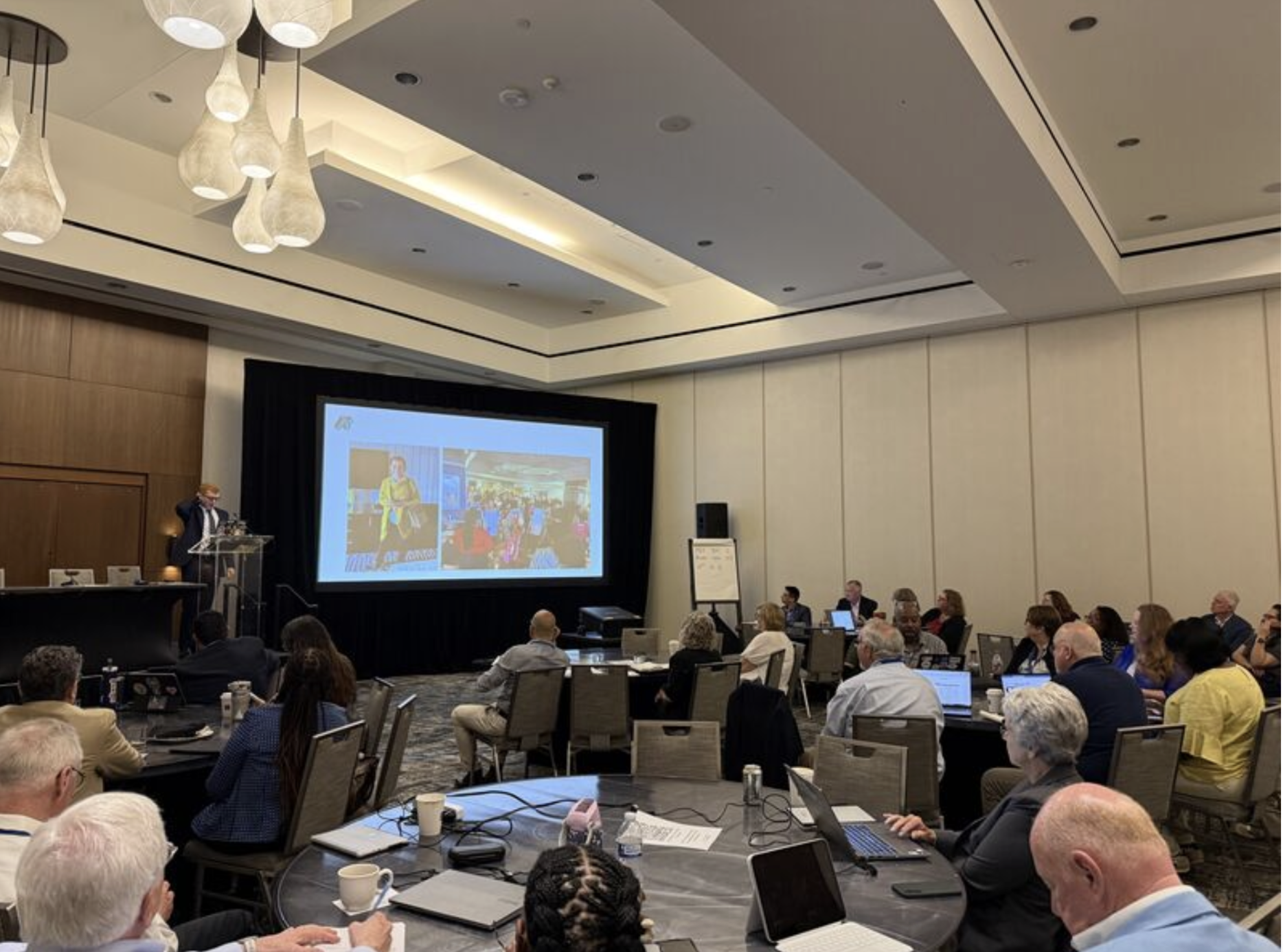
Alex delivered the keynote at the National Council of State Education Associations (NCSEA) Spring Convening on May 15 in Houston. Alex highlighted the importance of teachers, with a core message being that teachers are the main characters of the story about education in the age of AI. Vice President of External Affairs & Advocacy, Christian Pinedo, joined the AI Readiness Panel, where the discussion grounded readiness in human skills, explored what meaningful accountability looks like across every level of the system, and pushed back on the idea that complexity has to mean paralysis, helping attendees leave with a clearer sense of where to act.
AI Symposium in Indiana
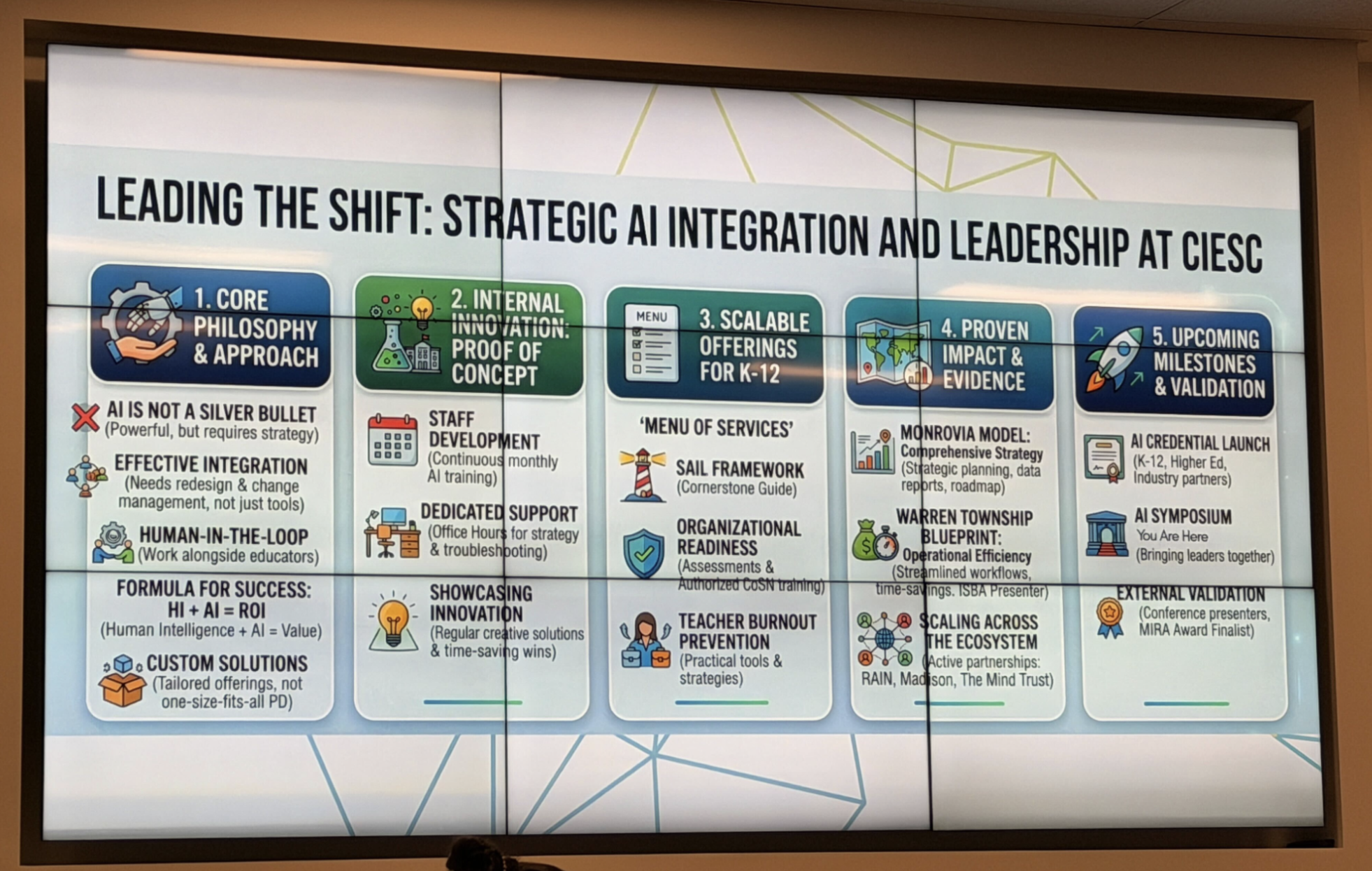
Central Indiana Educational Service Center (CIESC) hosted an AI Symposium in Indianapolis for educators, district leaders, and partners who are all leaning into the same big question: What does meaningful AI readiness actually look like for schools? aiEDU's Midwest Senior Programs Lead, Kristen Kayser, facilitated a session on "What AI Changes and What It Doesn't: A Framework for Educators" and participated in a closing panel conversation on the future of AI in Indiana schools. The day reinforced what we keep hearing across the country — there is real appetite among educators and systems leaders to move from awareness to action, and they're looking for partners to help them get there.
Opportunities for Educators
2026 Community Catalyst Program — Demand Outpacing Supply
Letters of Intent (LOIs) for the 2026 Catalyst Program were due last week and demand to join the program is ten times the amount we can offer in subgrants (140+ LOIs), which shows the importance and need for resources and opportunities to develop AI Readiness in underserved communities. The Community Catalyst Program funds school districts, educational service agencies, and nonprofits working to build real AI literacy in the communities that need it most. We prioritize rural and Indigenous communities that have historically been left out of the national conversations about technology and education. Grants range from $25,000 to $50,000 and run approximately 12 months beginning in summer 2026.
New Tools & Funding from EDSAFE
EDSAFE just released Polly C (in beta testing phase), a 24/7 AI policy navigator to help build district AI governance infrastructure. And their Spark Fund provides Technical Assistance Grants after completing their Policy Essentials course that schools could use to further invest in AI Readiness professional learning and implementation support.
Just Released! NEW aiEDU Classroom Curricula
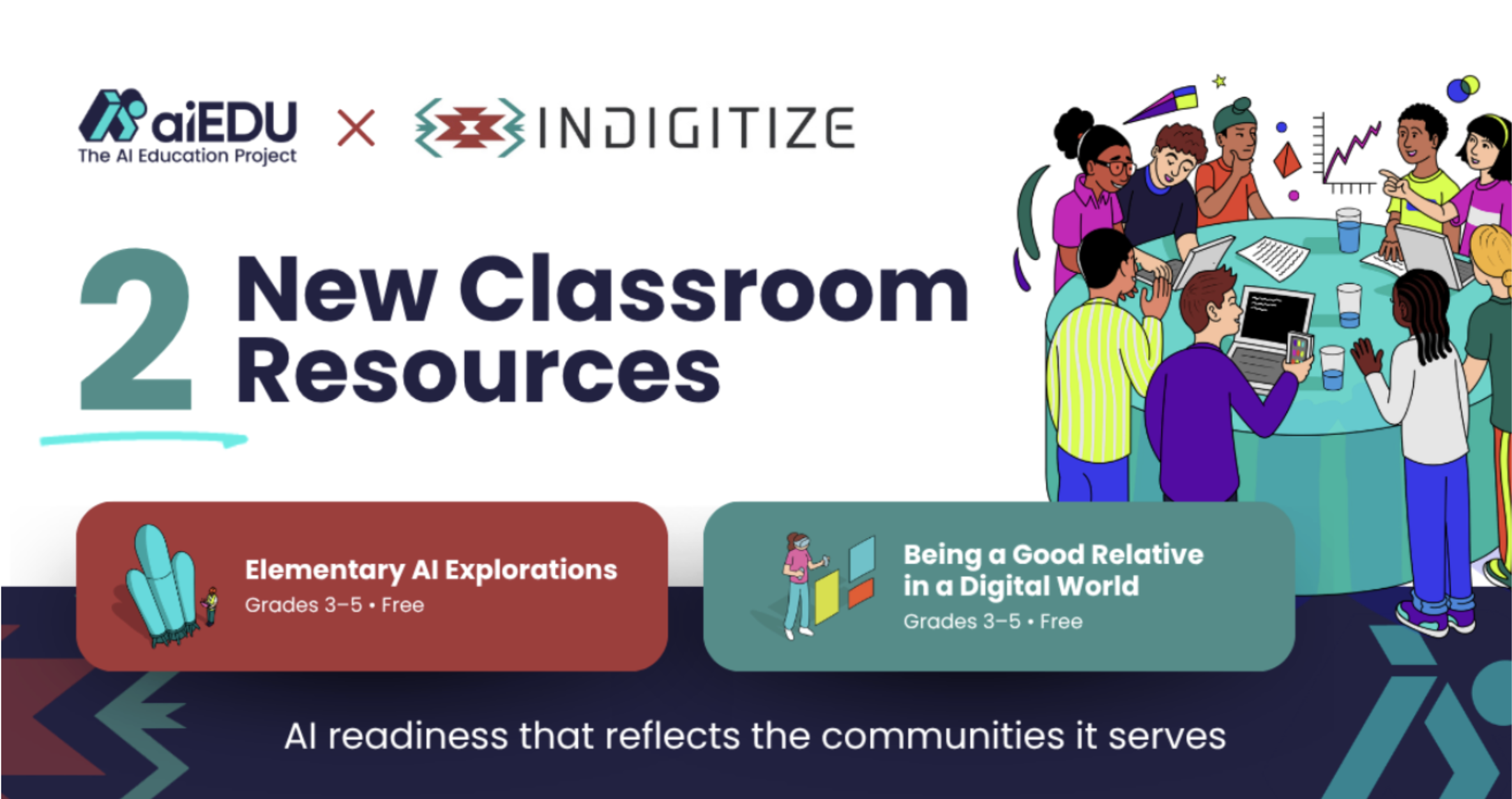
In partnership with Indigitize, aiEDU has released two free curricular resources for teachers in grades 3–5 that bring an Indigenous lens to AI literacy.
Elementary AI Explorations gives younger students a hands-on way to ask big questions: What is AI? Where does it show up? Who decides how it works? The activities are designed to be 15 minutes, with no tech setup required.
Being a Good Relative in a Digital World takes the concept of relationality—a value central to many Indigenous traditions—and applies it to digital life. Students explore what responsibility, community, and care look like when AI is part of the picture.
Thought Leadership & Advocacy
New Federal Legislation
The K-12 AI Literacy and Readiness Act of 2026 was introduced on May 12. The bill would amend the Elementary and Secondary Education Act to explicitly allow federal funds for student instruction on the safe, effective, and responsible use of AI and professional development for teachers, support staff, and others to use and teach AI effectively (summary and press release).
New AI Guidance from Michigan Department of Education (MDE)
Earlier this month, MDE published guidance to local school districts on how to best use AI in classrooms as the technology becomes more prevalent. MDE's AI webpage has been updated to include: AI Starter Guide for Districts, AI Comprehensive Guide for Districts, and a Michigan K–12 AI Learning Alignment Framework – CS, among other resources. Notably, aiEDU's resources were included in the comprehensive guide.
AI Readiness in the News
- Substack (5/1/26): AI Readiness Is An Organizing Problem
- aiEDU Studios Podcast (5/1/26): Michelle Culver, Founder of the Rithm Project — Why Human Connection Has to Be a Design Goal of School
- aiEDU Studios Podcast (5/7/26): Matt Sigelman, CEO and founder of the Burning Glass Institute — What Should Students Actually Learn Now?
- aiEDU Studios Podcast (5/14/26): Dr. Patrice Johnson, CEO of Project Scientist — Confidence, Not Skill
- Substack (5/17/26): What we learned after deploying $1.2M in rural & Indigenous grants
Looking Ahead
2026 Funders
April 2026
April was a month of convergence for aiEDU — at the ASU+GSV Summit in San Diego and in conversations with funders, educators, and policymakers. The thread connecting it all is one we keep coming back to: AI Readiness is no longer optional; it's essential to help every student live, work, and thrive in the age of AI.
This edition highlights two milestones we're especially proud of: the launch of an 18-month statewide planning initiative in Michigan, supported by the W.K. Kellogg Foundation, and the first-ever national cohort of Spark the Future, our flagship train-the-trainer experience now open to educators across the country.
Funder Spotlight

With support from the W.K. Kellogg Foundation, aiEDU launched an 18-month statewide planning initiative in Michigan in 2026 to better understand the state's unique needs and begin building the foundation for AI literacy and readiness across K–12 schools and communities.
The momentum is already growing. In the first quarter of 2026, aiEDU established active partnerships with Michigan Virtual and University Prep Schools, while advancing conversations with school districts across the state. We also launched a professional learning community for rural district leaders and welcomed 13 Michigan educators into a Midwest cohort of aiEDU's Trailblazer Fellowship, part of a broader network of 35 educators committed to leading this work.
In the months ahead, aiEDU will continue convening policymakers, educators, philanthropic leaders, and district partners to help co-create a shared vision—and a practical roadmap—for AI readiness across Michigan.
If you'd like to learn more or explore ways to support this work in Michigan, please reach out to Kristen Kayser and Josh Westfall.
Spotlight Event: ASU+GSV Summit
We had a whirlwind week in San Diego with friends and colleagues — co-hosting a vibe coding workshop for funders and speaking on three panels about AI readiness, durable skills, and the future of work.
Vibecoding Workshop for Philanthropy Leaders
Earlier this month, aiEDU attended the annual ASU+GSV Summit in San Diego. The Sunday before the conference aiEDU co-hosted a vibe coding workshop with Quill, Career Village, Gates Foundation, NewSchools Venture Fund, Stuart Foundation, Education Funder Strategy Group, and EdSolutions for 30 funders and nonprofit partners. The workshop was designed to accommodate the full spectrum of learners using AI tools—from beginners to those who are well along their AI learning journey. The activities were tool agnostic, with the goal to provide attendees the opportunity to go beyond chatbots to help folks use AI to write software code, unlock new possibilities, and replace the skepticism and fear around AI with curiosity, creativity, and agency.
Beyond the Pilot: AI's Real Impact on Learning Systems
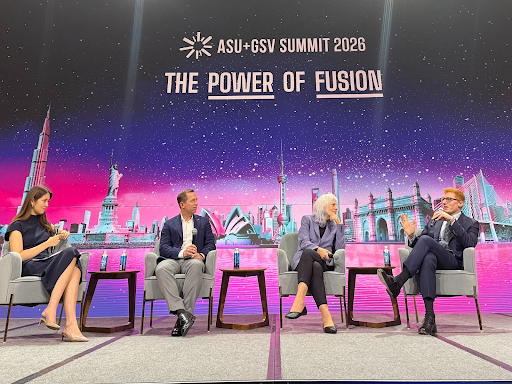
- Alex Kotran, CEO & Founder, aiEDU
- Candace Thille, Professor, Stanford University
- Kevin Mills, Head of Education & Government GTM, OpenAI
- Claire Zau, AI Lead & Partner, GSV Ventures
What Skills Matter Now?: How Districts Redesign Readiness for an AI-Driven Workforce

- Christian Pinedo, Vice President, External Affairs & Advocacy, aiEDU
- Carlo Salerno, Managing Director, Burning Glass Institute
- Emily Seefeldt, Director of Teaching & Learning, Red Wing Public Schools
Durable Skills + AI Fluency: Preparing Youth for the Future of Work
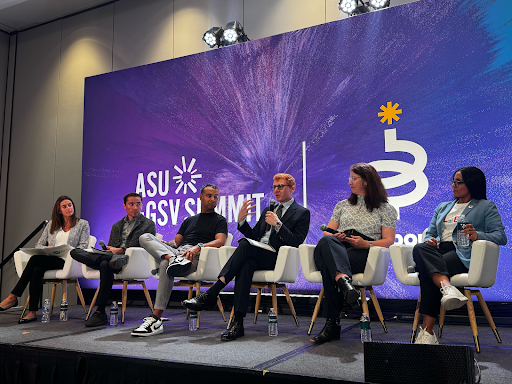
- Alex Kotran, CEO & Founder, aiEDU
- Lisa Dughi, CEO, NAF
- Zarek Drozda, Executive Director, Data Science 4 Everyone
- John Branam, Executive Director, Get Schooled
- Jaime Casap, Purpose Education Evangelist
Opportunities for Educators
Join aiEDU's First-Ever National Spark the Future Cohort
Educators across the country are being asked to help their schools navigate AI — but many are doing it without the training or support to lead that work confidently. That's why aiEDU is launching the first-ever national cohort of Spark the Future, our signature train-the-trainer experience designed for educators who are ready to become trusted leaders in AI readiness within their schools and districts and, most importantly, to support colleagues and peers on their learning journeys.
Previously offered only as a district-based program, Spark the Future is now available to individual educators and smaller district teams who want access to this high-impact professional learning experience. Registration opens April 27 and 90-minute live sessions are on June 4, 11, and 18. As part of the program, participants who complete the experience will also receive 30 licenses to aiEDU's Teaching for Tomorrow course to extend learning with colleagues in their own communities.
New Release: Elementary Explorations on Responsible AI Use
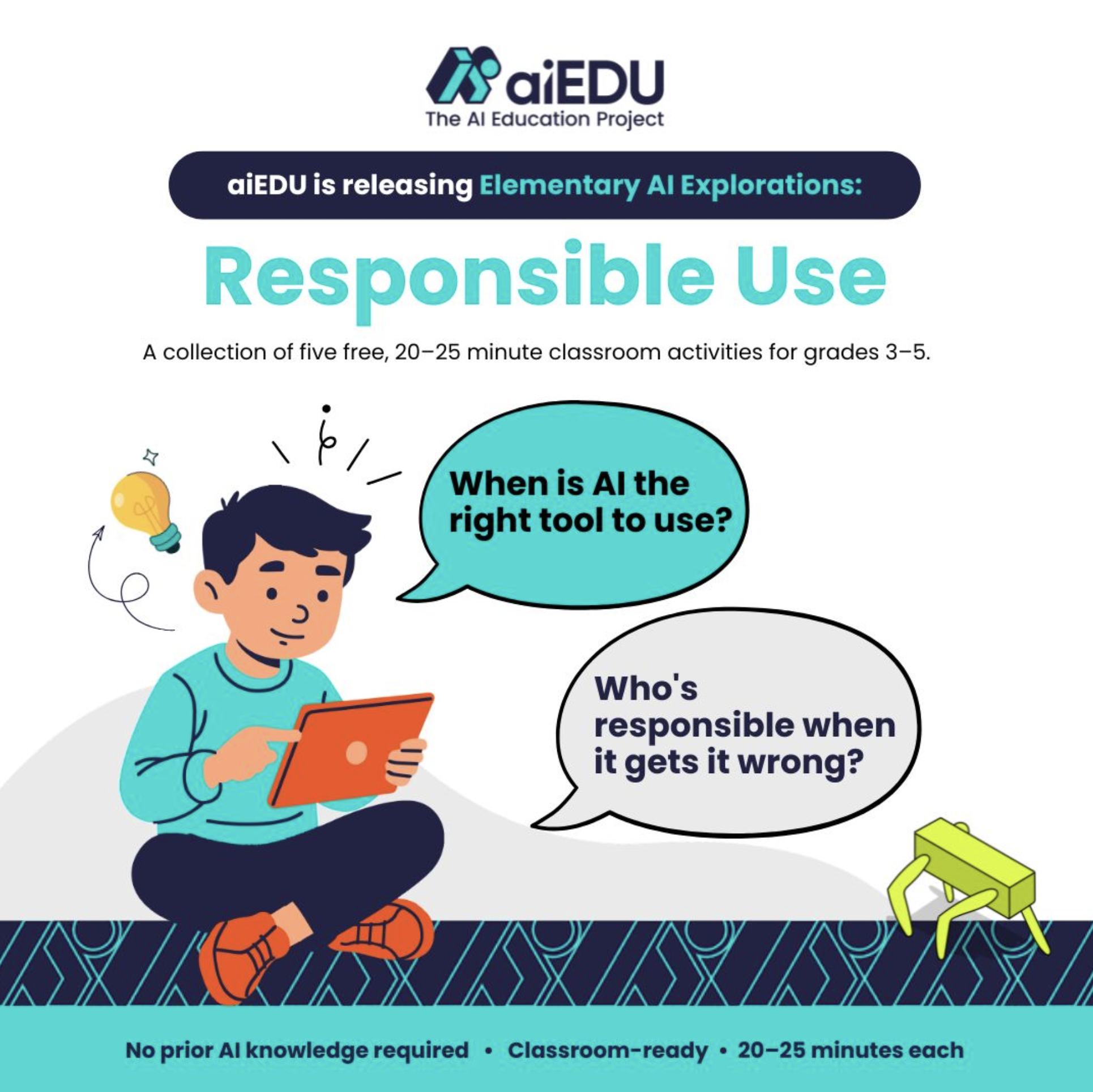
Developed to help students in grades 3–5 think critically about how, when, and why they use AI.
This new Responsible AI Use collection helps students in grades 3–5 begin exploring an important question: How can we use AI in smart and responsible ways? Through hands-on 20-minute activities, students practice choosing when AI can be helpful, recognizing when people should make the final decision (not AI), and understanding the difference between using AI as a tool for learning versus letting it do the thinking for them.
AI Readiness in the News
- Substack (4/9/26): Insights from 7 Vibecoding Workshops in 4 Weeks
- aiEDU Studios Podcast (4/9/26): Toni Wan, Head of Platform at Reach Capital — AI is Raising the Bar, Are Schools Keeping Up
- The Hill (4/12/26): As AI Pushes Students to Reconsider Majors, Universities Struggle to Adapt
- aiEDU Studios Podcast (4/16/26): Kaya Henderson, former Chancellor of DC Public Schools — Why the Former DC Schools Chancellor Says We're Underestimating Kids
Looking Ahead
2026 Funders
March 2026
We're excited to start this edition by highlighting that March 27 is National AI Literacy Day! It's a nationwide day of action dedicated to expanding AI Literacy for teachers and students across the country.
Organized by the EDSAFE AI Alliance, aiEDU, Common Sense Media, and The Tech Interactive, this event, now in its third year, invites students, parents, educators, and communities to engage with AI education through classroom activities, after-school programs, and professional development opportunities.
There are 60+ affiliate events happening across the U.S. on March 27 (see list here). If you are looking for something to post on social media and where aiEDU will be, view the briefing document here.
Spotlight: Vibecoding Workshop with Google DeepMind @ SXSW
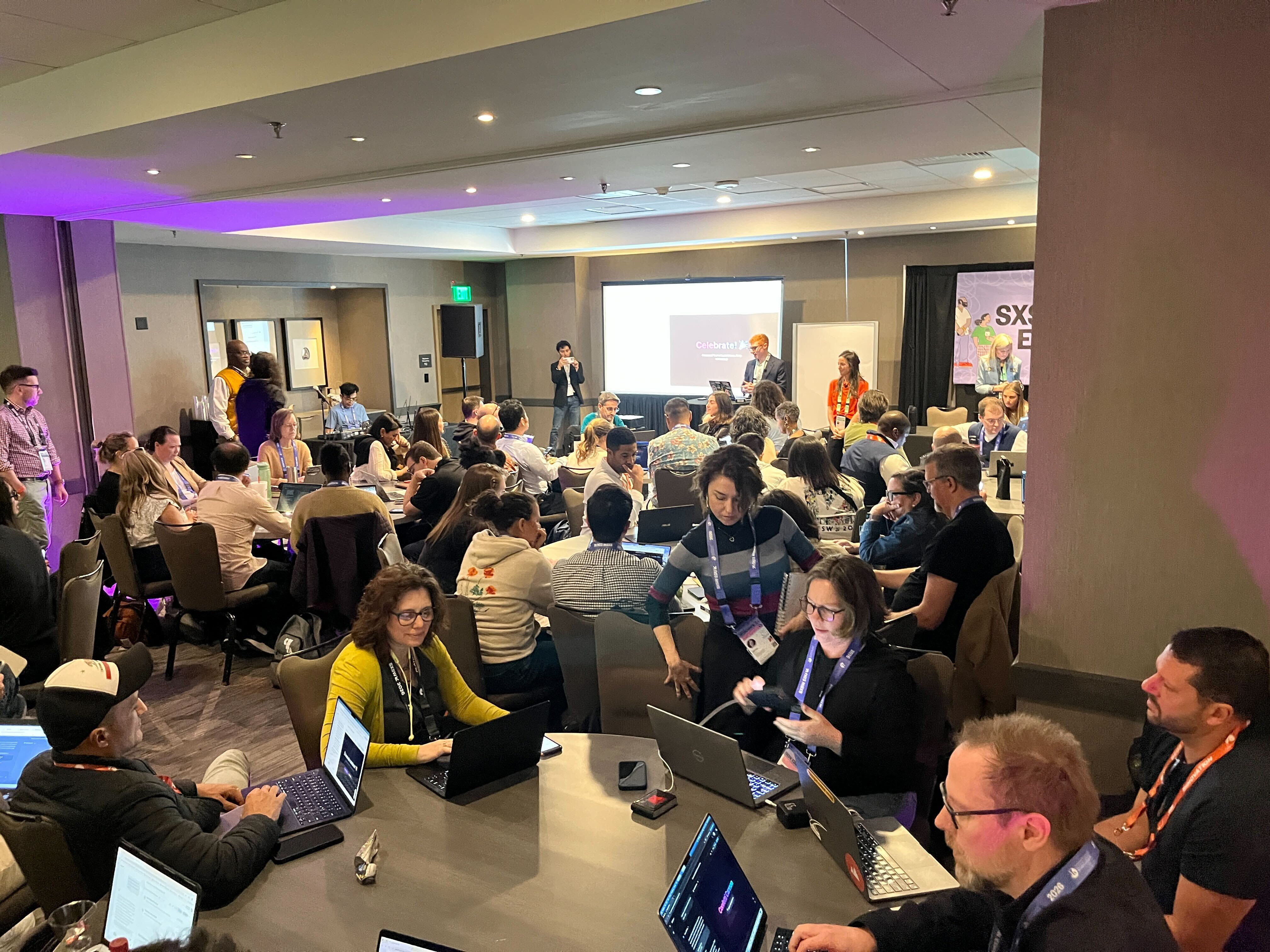
aiEDU and Google DeepMind teamed up at SXSW to bring a hands-on "vibecoding" experience to educators. The room was packed, with a line out the door of people eager to move beyond theory and actually build with AI. In just minutes, participants created their own learning tools and began to see what's possible when software can be built through conversation. aiEDU is continuing to find ways to get people hands-on experiences with these technologies, helping them build solutions to the real challenges they see in their day-to-day work. When you combine AI readiness, the opportunity that vibecoding unlocks, and the spark to explore, that's where these workshops truly shine.
Opportunities for Educators
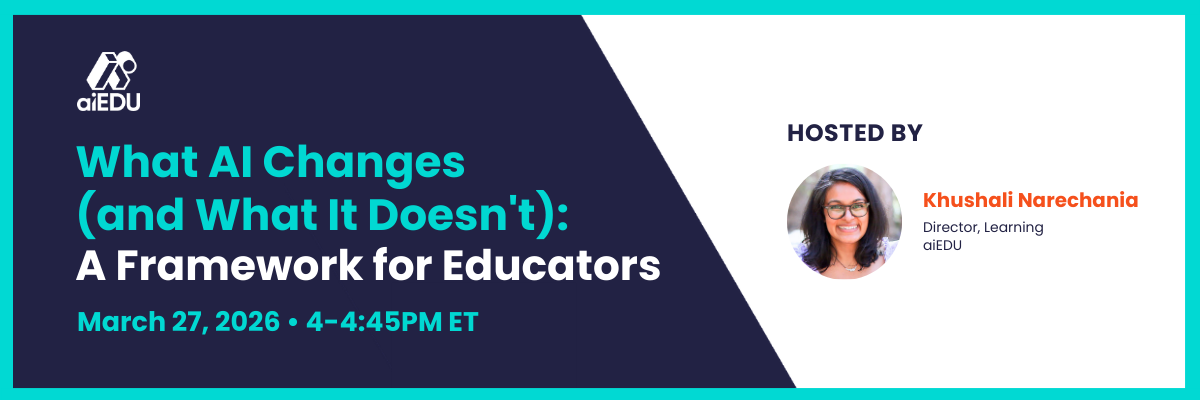
What AI Changes (and What It Doesn't): A Framework for Educators
This 45-minute session unpacks a data-driven framework from the aiEDU & Burning Glass Institute report "Which Skills Matter Now?" to help K–12 educators make sharper decisions about curriculum, instruction, and assessment in an age of AI. Participants will leave with a four-quadrant lens for analyzing any skill in your subject area, a concrete example of the framework in action, and practical strategies for adapting your assessment approach. Register for the webinar here.
Thought Leadership & Advocacy
AI Exploration Community Demo Day
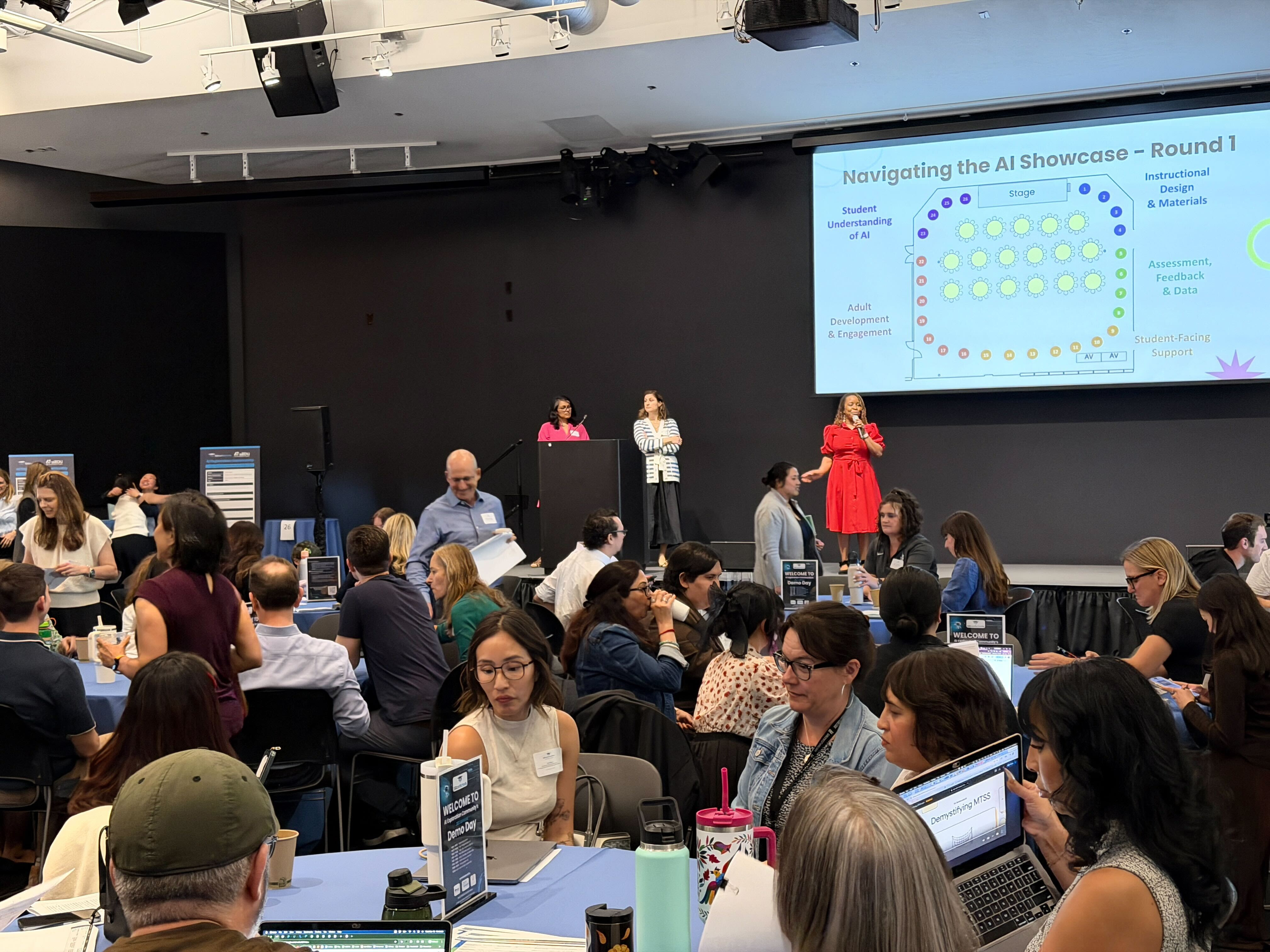
Silicon Schools and aiEDU have been partnering on a seven-month AI-enabled learning cohort that culminated on March 18 for the third annual "AI Exploration Community Demo Day." With 100+ educators in the room, they discussed and shared thoughtful ways K-12 teachers and education leaders across California are piloting AI to solve problems and accelerate student learning. The event included a science-fair-style session where participants were able to engage with educators to discuss challenges, opportunities, and their path forward using AI.
Keynote with State & National Policy Makers
A few weeks ago, Christian Pinedo, aiEDU's VP of External Affairs & Advocacy gave a keynote at the National Conference of State Legislature's (NCSL) Legislative Policy Academy on AI in K–12 Education and moderated a panel on what AI Readiness truly means for schools and systems today. Across sessions, the throughline was clear: policy conversations are rapidly catching up to the urgency of AI in education, but success will depend on investing in educators, building shared understanding, and keeping student outcomes at the center. We're encouraged to see growing momentum among state leaders and we're proud to help shape it alongside partners across the field.
AI Readiness in the News
- Substack (3/4/26): Everyone Needs to Vibecode ASAP
- aiEDU Blog (3/6/26): 150 Educators Across 35 States Begin aiEDU's Spring 2026 Trailblazer Fellowship
Looking Ahead
2026 Funders
February 2026
This month in AI Readiness, policymakers, educators, and the public are all grappling with the rapid rise of artificial intelligence. The U.S. Department of Labor unveiled a new Artificial Intelligence Literacy Framework to help workforce and education systems build broader AI skills across communities and prepare workers for an AI-driven economy. At the same time, debates over how AI should be regulated in education are intensifying — with states moving ahead on school AI policies. Meanwhile, Pew Research Center data shows Americans are increasingly concerned about AI's impact on daily life and human abilities, but also believe understanding AI is essential, revealing both anxiety and appetite for literacy and governance.
Opportunities in the Field
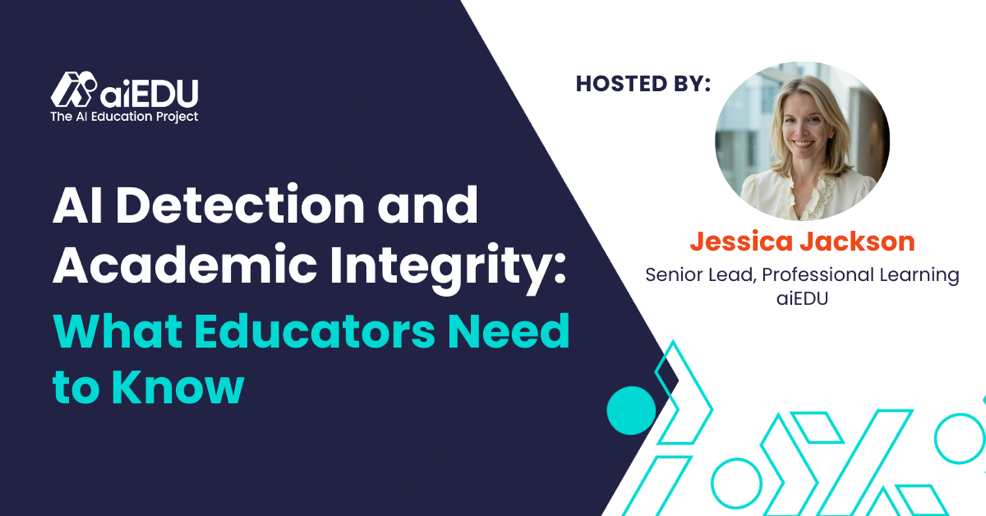
Wednesday, March 4, 2026 at 6:00-7:00 PM, ET
As AI becomes part of everyday learning, many schools are turning to AI detection software to address concerns about academic integrity. But what role should these tools really play? This webinar explores the limits of AI detection, how to respond when a student is flagged, and a broader, learning-centered approach grounded in transparency, dialogue, and student agency. Participants will gain practical strategies to support responsible AI use while protecting meaningful learning. Register Here.
Thought Leadership & Advocacy
New Report: Which Skills Matter Now?

Yesterday, The Burning Glass Institute and aiEDU released a new report, "Which Skills Matter Now? A Data-Driven Framework for K–12 in the Age of AI." This report provides a data-driven framework for K-12 educators to navigate the shift, analyzing AI's impact on 1,000 workforce skills and mapping the implications for 140 high school learning objectives. It offers a clear method for identifying where and how curriculum needs to be rebalanced.
New aiEDU Resources
Last month aiEDU published three new parent resources as part of a "Parents' Guide to AI." Each resource is provided in English, Spanish, and French.
AI Readiness in the News
- The Hill (2/4/26): States Race Forward on Education AI Regulations Despite Trump Objections
- The 74 (2/17/26): At These Universities, Using AI Isn't Shunned–It's a Graduation Requirement
- Substack (2/18/26): We Bet On A Second-Mover Advantage with AI Tools. It's Time To Move
Looking Ahead
2026 Funders
January 2026
Kicking off 2026, AI in K-12 education has dominated headlines with policymakers, educators, and researchers spotlighting both opportunities and challenges. From new statewide education requirements (e.g., Ohio requiring schools to adopt a formal policy on the use of AI (info below)) to trend reports identifying AI as the top state edtech priority, stakeholders are wrestling with how to govern, fund, and scale AI use responsibly. National surveys and teacher voices have underscored urgent needs for professional learning and clear implementation frameworks as AI tools become more common in schools, while thought leaders continue to call for ethical, equitable integration. These developments mark a pivotal moment for funders ready to support strategic investment in AI literacy, teacher capacity, policy development, and student-centered innovation.
This has also been a pivotal moment for aiEDU. This week we published the digital version of our 2025 Impact Report. A few highlights from the report include impacting 19,300+ educators and reaching 1.15 million students across the country. Additionally, we've secured 23 active district and school partnerships, 178 Trailblazer Fellows completed the program, 13 states cited aiEDU's AI Readiness Framework, and 7,600+ educators downloaded our curriculum and resources. Make sure to read the full report for more data, case studies, teacher spotlights, and event highlights.
Finally, as we are growing nationally, so is our aiEDU team with two new hires this month, including Jessica Jackson, Senior Lead for Professional Learning, and Kristen Kayser, Senior Lead of Midwest Programs.
Funder Spotlight
aiEDU has recently partnered with Amazon to provide AI Readiness training to community partners in New York City, NY, and Montgomery County, MD in Q1 2026. Additionally, aiEDU is leading a train-the-trainer program (Spark the Future) with Amazon's Future Engineer Teacher Ambassadors (19). Spark the Future trains educators to facilitate the Teach for Tomorrow course (aiEDU's asynchronous, virtual training) within their school, district, and community. Upon completion of the program, each trainer receives 30 licenses to aiEDU's online training platform to launch their own training within one year of the completion date.
Opportunities in the Field
Applications for the 2026 Trailblazer Fellowship cohort are open for all educators to submit an application. The Trailblazer Fellowship is aiEDU's premier AI Readiness program that provides teachers the space and network to learn and build their own AI readiness skills and shape aiEDU curriculum with feedback from the classroom. The fellowship is a 10-week commitment with synchronous sessions, asynchronous activities, a $875 stipend, and a certificate of completion.
Applications open Sunday, January 25 and close Sunday, February 8. Review & Share Application.
Thought Leadership & Advocacy
New Partnership with ETS
A new partnership with ETS was announced in January that combines ETS's global expertise in assessment, measurement, and research with aiEDU's innovation in curriculum design, educator preparedness, and professional development. Guided by a shared commitment to safety, privacy, fairness, and transparency in AI design and deployment, together our organizations will build the tools, knowledge, and pathways to empower students, educators, and policymakers to thrive today and tomorrow. Key collaboration areas include: research and measurement, educator professional development, and policy and systems engagement.
Ohio

At the end of 2025, The Ohio Department of Education & Workforce announced a requirement for Ohio traditional public school districts, community schools, and STEM schools to adopt a formal policy on the use of artificial intelligence (AI) by July 1, 2026. To support this statewide initiative, the Ohio Department of Education and Workforce, informed by the work of the Ohio AI in Education Coalition, developed a model policy that schools may choose to adopt. The announcement names aiEDU's AI Toolkit for Ohio's K-12 school districts as the foundation for the model policy.
California

aiEDU has been collaborating with California State Senator Sasha Renée Pérez on SB 845 to expand and improve career technical education (CTE), work-based learning, and youth apprenticeship programs in high schools in California. Specifically, aiEDU has worked to emphasize the importance of AI Readiness in California's CTE standards. The bill has passed the Senate and will move to the Assembly for consideration.
AI Readiness in the News
- The 74 (12/11/25): What Does AI Readiness Mean for Schools?
- Politico (1/9/26): 5 Questions for Alex Kotran
- aiEDU Blog (1/13/26): The AI Innovation Fellowship from aiEDU and the Urban Assembly
- Press Release (1/15/26): Charting the Future: ETS and aiEDU Collaborate to Transform AI Literacy and Readiness in Education
Looking Ahead
2026 Funders
December 2025
This month features highlights from aiEDU's work with rural educators and Idaho schools, new partnership opportunities, and continued advocacy at the state level.
Highlights
Phoenix Event with Leading Educators, RAISE, and aiEDU
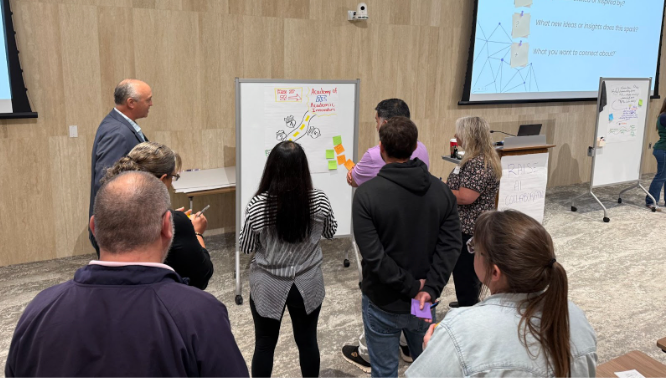
Rural educators from across the Southwest gathered in Phoenix, AZ for the RAISE AI Collaborative, a months-long community of practice co-led by Leading Educators, aiEDU, the Arizona Institute for Education & the Economy, and Collegiate Edu-Nation.
District-based teams spent the fall aligning instructional vision, testing AI-enabled practices, and surfacing the policy and infrastructure needed for safe and effective AI use. The meeting brought these teams together to synthesize learning, exchange strategies, and design next steps rooted in real district priorities rather than abstract trends.
The result is a growing network of rural educators leading the way in shaping coherent, equity-centered AI integration for their communities. Access Video & Blog.
Activations at the Idaho STEM Action Center
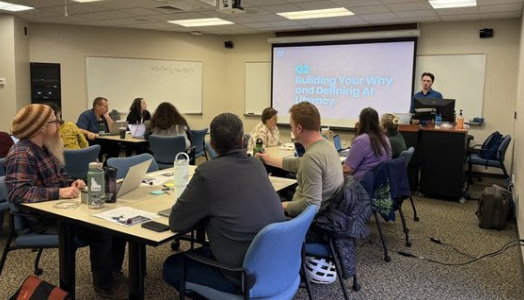
Last month, we hosted professional learning sessions across Idaho. In partnership with the Idaho STEM Action Center, educators gathered in Coeur d'Alene and Pocatello to strengthen their AI literacy and readiness, exploring how to integrate AI into teaching and learning in ethical, responsible, and effective ways. Sessions were led by our Trailblazer Alum and now Trailblazer Facilitator, Connor Mulvaney
Opportunities for the Field
aiEDU and Quill.org are teaming up to provide a free, year-long AI literacy curriculum during the 2025-26 school year.
Building on Quill's Reading for Evidence tool and aiEDU's nationally recognized AI Snapshots curricula, the curriculum weaves critical thinking about artificial intelligence directly into daily literacy and STEM instruction for students in grades 8-12.
What is the Curriculum?
- 21 instructional modules designed for grades 8–12
- 10-minute aiEDU warm-ups paired with 15-minute Quill reading & writing activities
- Grouped into packs of three by theme
Thought Leadership & Advocacy
Testimony at Pennsylvania Senate Majority Policy Committee: Protecting Kids from Harmful AI
In November, Christian Pinedo, aiEDU's VP of External Affairs, testified before the Pennsylvania Senate Majority Policy Committee on protecting children from harmful uses of AI. He shared the perspectives of K–12 educators and administrators who are committed to safeguarding students from unhealthy chatbot interactions and AI-generated exploitation while building the literacy and readiness needed for safe, responsible use. View the full hearing and Christian's testimony.
New Resources

New AI Snapshots: "Evaluating AI Outputs," a new collection of 10 classroom-ready Snapshots designed to help middle and high school students build the habits they need to interact thoughtfully with AI. Download snapshots.
Watch the latest episodes (5) of "Raising Kids in the Age of AI" with Alex Kotran and Dr. Aliza Pressman.
Looking Ahead at Fall 2025
2025 Funders
September 2025
September was a busy month for AI education news. On the investment side of things, Zoom Cares announced a three-year, $10 million commitment to AI For Good to help build global AI readiness and positive societal impact; NVIDIA announced $25 million to support K-12 AI education programs; and OpenAI launched their first wave of grant applications for their $50 million commitment to the A People-First AI Fund. In the public sector, the National Science Foundation (NSF) announced an invitation for supplemental funding to expand K-12 resources for AI education.
Many of these announcements were in connection to the second meeting of the White House Task Force on AI Education earlier this month (more on this later). Nonetheless, these recent funding initiatives are a good signal for growing commitment to integrating AI education into K–12 schools, including resources, training, and support for educators and students nationwide.
Funder Spotlight
The Raikes Foundation, EdSolutions, and aiEDU will be leading a session on "Equity in the Age of AI: What Every Funder Must Ask Before AI Changes Everything" on October 21 at 2:15pm, CT at the Grantmakers for Education 2025 Annual Conference in Memphis, TN. You won't want to miss this interactive session that dives deep into the equity risks, funding blind spots, and systemic leverage points that AI introduces. Session attendees will co-create actionable resources, developed through thoughtful debate, to equip funders with critical questions to fund transformational change in education.
Opportunities for the Field
aiEDU hosted a unique workshop for parents and students at Juan Morel Campos in Brooklyn, New York. The event provided 50 families the opportunity to learn more about practical uses of LLMs, like Gemini including its Guided Learning feature. Parents and students built their own study guides and learned more about AI's responsible use cases for studying.
Thought Leadership & Advocacy

At the federal level, Alex Kotran attended the second White House Task Force on AI Education meeting in Washington, DC. The key takeaway from the meeting was that AI education concerns and opportunities have moved from a niche topic to a cabinet-level national priority positioning "AI Readiness" as essential for U.S. economic and national security. Read Alex's substack post for more details about the meeting.
Additionally at the federal level, U.S. Senators Bill Casidy (R-LA), Jon Husted (R-OH), and Lisa Blunt Rochester (D-DE) introduced the Recommending Artificial Intelligence Standards in Education (RAISE) Act. The bill adds AI and emerging technology to the list of subjects that states may establish standards for in the Elementary and Secondary Education Act (ESEA) of 1965.
Finally, Christian Pinedo, VP of External Affairs & Advocacy, was tapped to participate as a member of the California AI in Education Workgroup for public schools to develop statewide guidance and a model policy to ensure AI benefits students and educators while safeguarding privacy, data security, and academic integrity. Here's a short analysis of the first meeting.
New Resources
Last week, aiEDU Studios dropped the first episode of our new series, Raising Kids in the Age of AI. It's produced in collaboration with Google and co-hosted by Dr. Aliza Pressman, the NYT bestselling author of The 5 Principles of Parenting.
aiEDU recently released Version 2.0 of the AI Readiness Framework — a comprehensive guide for preparing students, educators, and school systems for an AI-driven future. Developed with research from The Burning Glass Institute, it balances AI literacy with essential human skills like critical thinking and collaboration. Feel free to review and share our resources as you see fit: V2 AI Readiness Framework, press release, LinkedIn post, and additional resources on our webpage.